
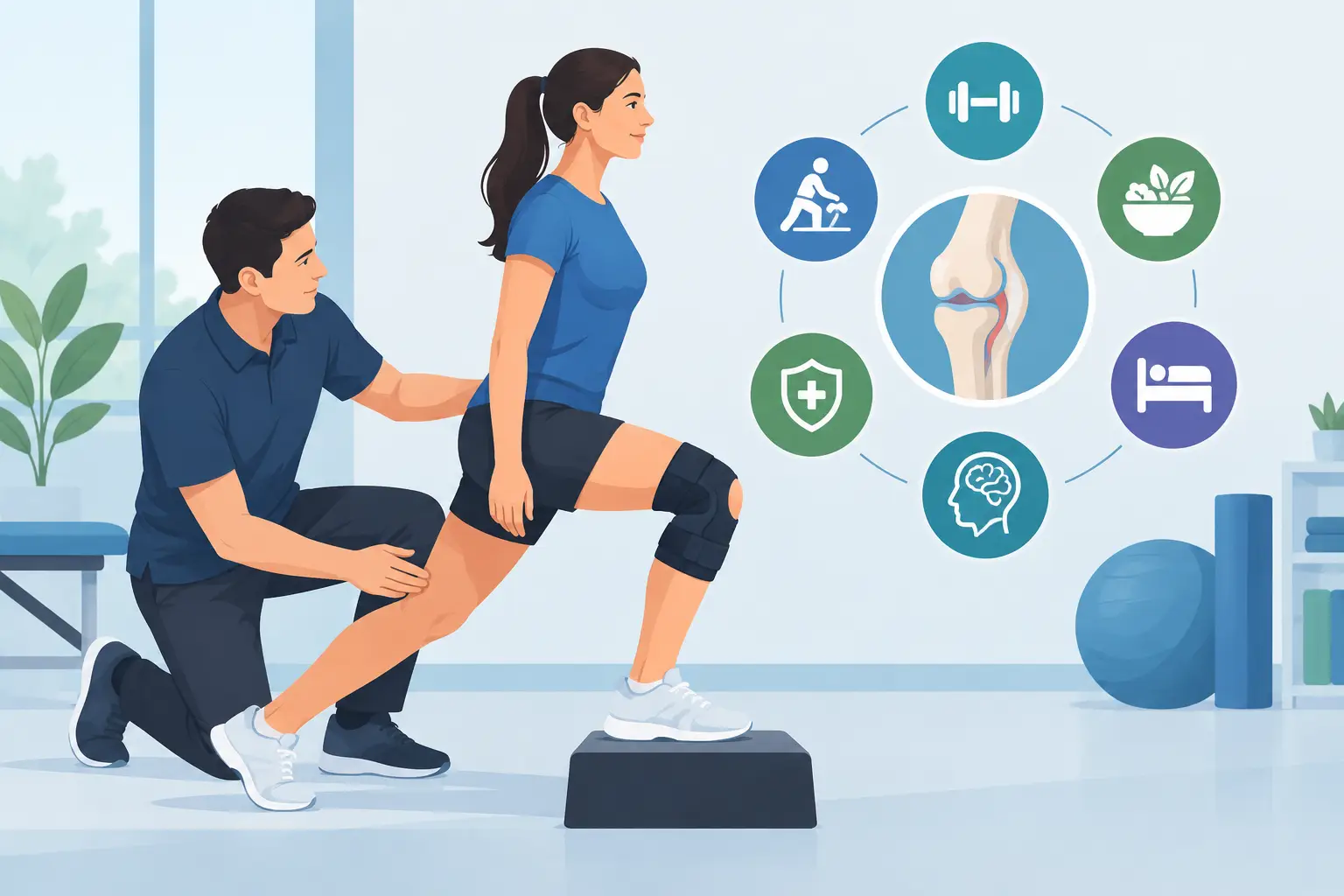
ACL Rehabilitation Outcomes: What Shapes Recovery
A torn ACL can make everyday movements feel uncertain long before sport is even part of the conversation. Strong ACL rehabilitation outcomes are not defined only by whether the knee feels less painful. They are about restoring confidence, control, strength, and the ability to return safely to the activities that matter to you – whether that means skiing, soccer, lifting at the gym, chasing children, or simply walking stairs without hesitation.
Recovery is rarely a straight line. A knee may feel good one week and swollen or stiff after a new activity the next. That does not automatically mean something has gone wrong. It does mean your rehabilitation plan should respond to what your knee is telling you, rather than forcing your recovery to follow a calendar.
What do successful ACL rehabilitation outcomes look like?
A successful result is personal, but there are several practical markers that matter for most patients. Early on, the goals are usually to settle swelling, regain knee straightening, restore a comfortable walking pattern, and reactivate the quadriceps. Later, rehabilitation shifts toward building strength, balance, landing control, endurance, and confidence with more demanding movement.
For an active person, a positive outcome may include returning to cutting, pivoting, jumping, or recreational sport with appropriate testing and preparation. For someone whose main goal is daily function, success may mean getting back to work, stairs, errands, and exercise without recurring instability or fear of the knee giving way.
Pain relief is useful, but it is not the only measure. A knee can be relatively pain-free while still lacking the strength and control needed for a safe return to higher-impact activity. Likewise, a patient can have some discomfort during rehabilitation while making meaningful functional gains. Your therapist looks at the full picture: symptoms, swelling, range of motion, strength, movement quality, and activity tolerance.
Surgery is one decision, not the whole recovery
Some ACL tears are managed with reconstruction surgery, while others can be managed without surgery through structured rehabilitation. The right path depends on the nature of the injury, knee stability, associated damage such as meniscus injury, activity demands, age, health history, and personal goals.
ACL reconstruction can improve mechanical stability for people who want to return to pivoting sports or who continue to experience instability. However, surgery does not replace rehabilitation. In fact, the work before and after surgery has a major influence on recovery. Entering surgery with good knee motion, less swelling, and better quadriceps function can support the next stage of rehabilitation.
Non-operative care can also produce very good results for selected patients. If you do not have repeated giving-way episodes and your goals do not involve high-demand pivoting activity, a well-designed strength and neuromuscular control program may be an appropriate option. The key is an honest assessment and ongoing monitoring. If the knee repeatedly buckles, the risk of further joint injury can increase.
The milestones that matter most
Time since injury or surgery provides useful context, but time alone should not decide when you progress. Two people at the same point in recovery can have very different swelling levels, strength, movement patterns, and readiness for activity.
Early phase: calm the knee and restore movement
In the early weeks, the priority is often to reduce swelling and regain full knee extension, meaning the ability to straighten the knee fully. Limited extension can affect walking and make it harder for the quadriceps to work effectively. Flexion, or bending the knee, also needs to improve gradually based on your procedure and your clinician’s guidance.
Walking mechanics matter. Limping for too long can reinforce compensations at the hip, ankle, and lower back. Early exercises are not meant to be dramatic. They are meant to establish the foundations for everything that comes later.
Middle phase: build dependable strength and control
As symptoms settle, rehabilitation becomes more demanding. Quadriceps strength is especially important after an ACL injury or reconstruction, but it should not be the only focus. The hamstrings, glutes, calves, trunk, and hip muscles all contribute to how the leg absorbs force and controls movement.
This stage often includes progressive resistance training, step work, single-leg exercises, balance drills, cycling, and carefully selected conditioning. The aim is not just to make exercises harder. It is to build capacity without repeatedly causing significant swelling, sharp pain, or a lingering loss of motion.
Later phase: prepare for real-life demands
Running, jumping, landing, deceleration, and change-of-direction work should be introduced when the knee is ready, not simply because a certain number of months has passed. A person returning to a physically demanding job may need many of the same movement qualities as an athlete: leg strength, endurance, balance, and the ability to react without the knee collapsing inward.
For return to sport, clinicians may use strength testing, hop testing, movement assessment, and sport-specific drills. These tests do not guarantee that reinjury will not happen, but they provide much better information than relying on confidence alone.
Why some recoveries take longer
Recovery timelines vary widely, and that can be frustrating. A slower progression is not necessarily a poor outcome. It may reflect the demands of your sport, the complexity of the injury, a second procedure such as meniscus repair, persistent swelling, reduced strength before surgery, or challenges fitting rehabilitation around work and family life.
Fear of movement can also affect progress. After a sudden knee injury, it is understandable to protect the leg. But avoiding all challenging movement for too long can leave the knee underprepared. Good rehabilitation builds exposure gradually. You learn that the leg can tolerate more, then demonstrate it through controlled movement.
Consistency makes a meaningful difference. One long session followed by several missed weeks usually does less than regular, progressive work that fits your schedule. The best program is not the most complicated one. It is the one you can perform consistently, progress safely, and connect to your real goals.
Sleep, nutrition, stress, and overall conditioning also influence recovery. They do not replace physiotherapy, but they affect how well the body responds to training and how manageable the process feels.
Measuring progress beyond how the knee feels
A thorough physiotherapy assessment helps make progress visible. Your therapist may track knee range of motion, swelling, walking quality, single-leg control, strength, functional tasks, and your response after activity. This gives you objective checkpoints when motivation dips or when the knee feels different from one day to the next.
Comparing the injured and uninjured sides can be helpful, but it has limits. The uninjured leg may also lose strength during a period of reduced activity. Your assessment should also consider your body size, movement history, sport or job demands, and the quality of your movement under fatigue.
A return-to-sport decision should be shared, not rushed. Your surgeon, physiotherapist, coach where appropriate, and you each have useful information. The goal is to make a decision based on function and risk, not pressure from a season, an event, or a target date.
When to check in sooner
Contact your healthcare provider if you experience a new giving-way episode, a notable increase in swelling, a locked knee, calf pain or unusual swelling, fever, worsening redness around a surgical incision, or pain that is escalating rather than gradually settling. These symptoms need assessment rather than a wait-and-see approach.
At Royal Oak Physio, Chiro, and Massage Clinic, a licensed physiotherapist can assess how your knee is moving, identify the factors limiting progress, and build a plan around your work, activity level, and recovery goals. When needed, care can be coordinated with other services to support the surrounding pain, stiffness, or movement limitations that can develop during rehabilitation.
Your ACL recovery does not need to look exactly like anyone else’s. Focus on the next meaningful gain: a straighter knee, a stronger step, a steadier landing, or more trust in your leg. Those small, measured improvements are what build a lasting return to movement.