
Best Recovery Methods After an Ankle Sprain
A rolled ankle can feel like a minor setback until every step, stair, or attempt to return to sport reminds you that it is not. The best recovery methods after ankle sprain are not about pushing through pain or waiting passively for swelling to disappear. They combine early protection, the right amount of movement, progressive strengthening, and a clear plan for returning to the activities that matter to you.
An ankle sprain affects ligaments, the strong bands of tissue that help hold the joint stable. Recovery time varies. A mild sprain may settle within a few weeks, while a more significant injury can take months and needs more structured rehabilitation. The goal is not simply to get rid of pain. It is to restore motion, strength, balance, and confidence so the ankle is less likely to roll again.
Start With Protection, Not Complete Rest
In the first day or two, protect the ankle from further injury. If walking causes a pronounced limp, use a supportive brace, crutches, or both until you can take more normal steps. Continuing to limp heavily can irritate the ankle and alter how your knee, hip, and back move.
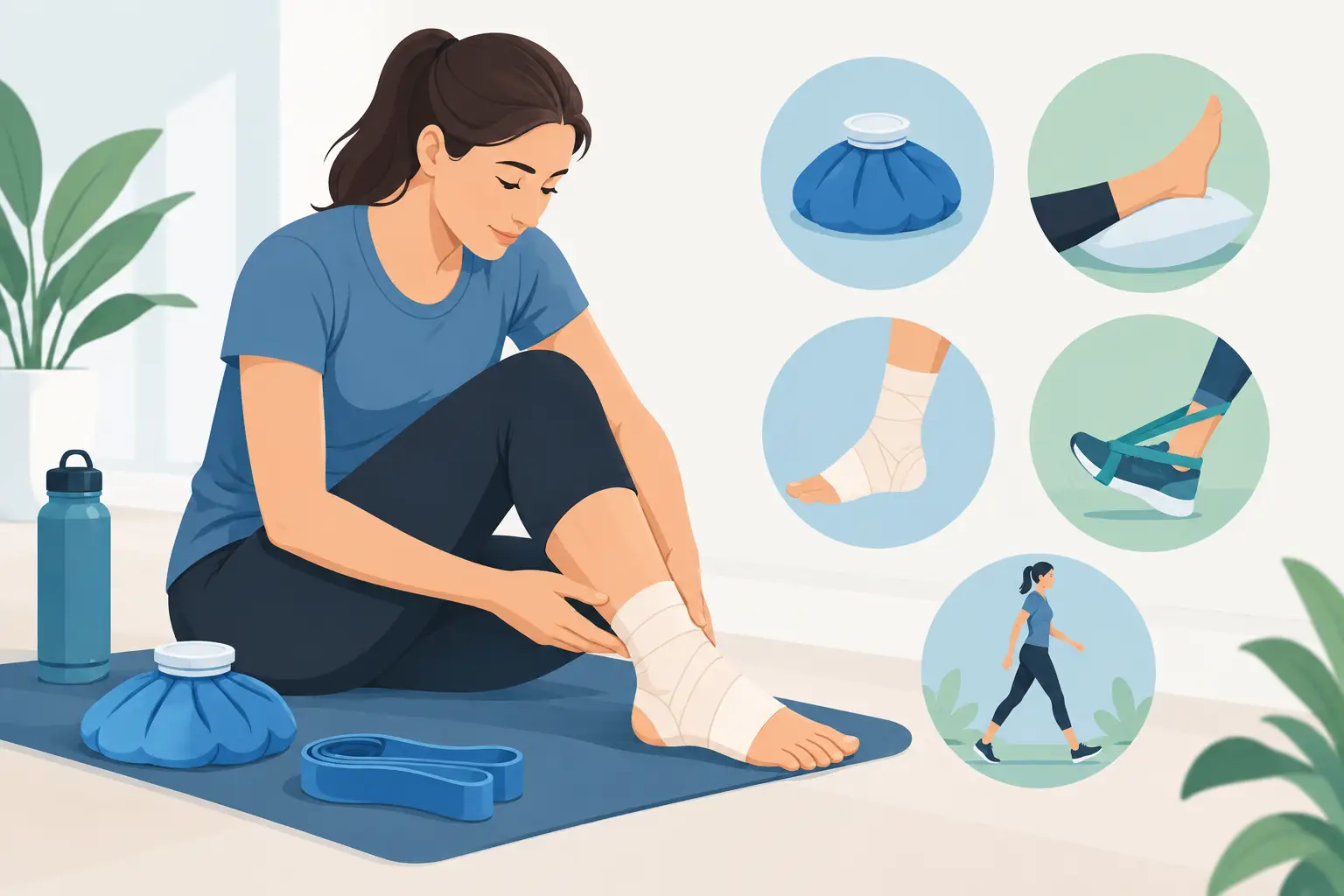
Compression with an elastic wrap or ankle sleeve can help manage swelling and provide a sense of support. Elevating the foot above heart level when resting may also reduce fluid buildup. Cold packs can offer short-term pain relief, particularly after an acute injury, but they are not a cure for ligament healing. Use a cloth barrier and apply cold for brief periods rather than directly on the skin.
The old advice to rest completely for days is usually not the best approach. Once serious injury has been ruled out, gentle, pain-limited movement helps prevent stiffness and keeps the surrounding muscles engaged. The trade-off is simple: too much activity too soon can increase swelling and pain, while too little movement can make the ankle weaker and slower to recover.
Know When an Ankle Sprain Needs Urgent Assessment
Some ankle injuries need medical assessment promptly rather than home care. Seek urgent help if you cannot take four steps after the injury, have severe or worsening pain, obvious deformity, numbness, a cold or pale foot, or significant tenderness directly over the ankle or foot bones. These signs can point to a fracture or another injury that needs imaging or immediate treatment.
It is also wise to book an assessment if swelling and pain are not improving over several days, the ankle repeatedly gives way, or you have diabetes, reduced circulation, or a condition that affects sensation. A high ankle sprain, which involves ligaments above the ankle joint, often feels different from a typical rolled ankle and may take longer to heal.
Best Recovery Methods After an Ankle Sprain: Restore Motion Early
When acute pain begins to settle, start with gentle range-of-motion work. Move the ankle up and down as if pressing and releasing a gas pedal. Make slow circles in each direction, or trace the alphabet with your toes while seated. These movements should feel mildly stiff, not sharply painful.
Restoring ankle motion matters because a stiff ankle changes how you walk, squat, climb stairs, and land from a jump. Limited upward ankle motion can also place extra stress on the knee, Achilles tendon, and plantar fascia. Small, frequent sessions are generally more useful than one aggressive stretching session.
A physiotherapist can assess whether stiffness is coming from swelling, muscle guarding, joint restriction, or a more specific injury pattern. Hands-on treatment may be appropriate in some cases, but it works best when paired with active exercises that help you keep and use the motion gained.
Rebuild Strength in the Muscles That Protect the Joint
Ligaments need time to heal, but the muscles around the ankle play a major role in preventing future sprains. Calf raises, resistance-band movements, and controlled weight-bearing exercises gradually rebuild the ankle’s capacity to handle walking, uneven ground, and sport.
Early strength work may start with pushing the foot gently into a band in four directions: upward, downward, inward, and outward. As symptoms improve, progress to double-leg calf raises, then single-leg calf raises. Quality matters more than high repetitions. If the ankle becomes more swollen or increasingly painful later that day or the next morning, the exercise dose may be too high.
Your hips and trunk deserve attention as well. Weakness or poor control higher up the leg can make the knee collapse inward and increase the chance of another ankle roll. A complete rehabilitation plan may include squats, step-downs, hip-strengthening work, and movement coaching, depending on your goals.
Balance Training Is What Many People Skip
Pain often improves before the ankle is truly ready for normal activity. This is why people can feel “fine” walking around, then sprain the same ankle again on a curb, trail, or court. Balance training helps retrain proprioception, your body’s ability to sense joint position and react quickly when the surface changes.
Start by standing on the injured leg near a counter or wall for support. When that is comfortable, add challenges such as closing your eyes briefly, reaching with the opposite foot, or standing on a softer surface. Athletes may later progress to hopping, cutting, landing, and sport-specific drills.
These exercises should be matched to your actual demands. Someone returning to recreational soccer needs a different final stage than someone who wants to walk their dog comfortably through the neighbourhood or manage stairs at work without hesitation.
Use Bracing and Footwear Strategically
An ankle brace can be useful during the early return to activity, particularly if the joint feels unstable or you are returning to a sport with jumping and quick direction changes. It should support recovery, not replace rehabilitation. Wearing a brace while avoiding strength and balance work leaves the underlying problem unresolved.
Footwear also matters. Supportive shoes with a stable heel and adequate grip are often a better choice during recovery than worn-out runners, loose sandals, or high heels. If foot mechanics are contributing to repeated ankle strain, an assessment may identify whether orthotics or footwear changes could help. This is not necessary for every sprain, but it can be valuable for people with recurrent injuries or persistent symptoms.
Return to Activity With Simple Benchmarks
There is no single calendar date that guarantees a safe return to running, work, or sport. A better guide is how well the ankle performs. Before returning to higher-impact activity, you should be able to walk briskly without a limp, move the ankle close to the same range as the other side, and complete calf raises and single-leg balance tasks without increased pain or swelling.
For running and court sports, progress gradually. Begin with straight-line jogging, then add speed, stopping, turning, and jumping over several sessions. Do not make every increase at once. Adding distance, intensity, and uneven terrain in the same week is a common way to flare up a recovering ankle.
When Guided Rehabilitation Makes a Difference
A licensed physiotherapist can identify the severity of the sprain, screen for associated injuries, and build a progression that fits your work, sport, and home life. Treatment may include education, hands-on care, exercise therapy, taping or bracing advice, and a return-to-activity plan. Massage therapy may help address protective muscle tension in the calf or foot, but it should be part of a broader program rather than the only treatment.
At Royal Oak Physio, Chiro, and Massage Clinic, care is focused on practical progress: reducing pain, restoring movement, and helping you return to the activities you rely on. Coordinated care can be particularly helpful when an ankle injury affects more than the ankle, such as calf tightness, altered walking, knee discomfort, or low-back irritation after limping.
A sprained ankle deserves more attention than a few days off and a hopeful test run. Give it the support, movement, and progressive loading it needs now, and you give yourself a better chance of moving confidently on the next trail, staircase, field, or busy workday.